What to Ask the Planning Office Before Buying Vacant Land
Found your parcel on GIS? Here’s what to verify next.

Finding land on a map does not establish that your plans are allowed.
After our parcel number, GIS map and land records guide, contact the office responsible for land-use rules. This conversation supports the zoning, setbacks and land-split checks in LandGauge’s land due-diligence checklist. Access, utilities, title and site conditions still need separate investigation.
Ask about rules, approvals and unanswered questions. Requirements vary by jurisdiction and parcel.
1. Gather four things before contacting planning
- Parcel number: Often called an APN, PIN or tax-map number.
- Location: Street address if available, plus a map link showing the parcel.
- Jurisdiction: The government responsible for land-use decisions.
- Intended use: A specific description of what you want to do.
“I want one year-round home, a detached shop and a private driveway” is more useful than “Is it buildable?” Mention manufactured housing, rentals, camping or business activity if those are part of your plan.
Ask: “Does your office administer zoning for this parcel?” A mailing address does not necessarily identify the governing authority. Inside a municipality, contact city or town planning; outside it, county planning may be responsible. Confirm rather than assume.
In Connecticut, start with the town or city, not a county planning office. For example, Simsbury’s planning department administers its local zoning regulations.
2. Which zoning district and current rules apply?
Ask for the district’s full name, the official zoning map and the applicable code sections. An overlay adds rules to the underlying zoning district, such as historic or hillside requirements.
Ask whether overlays, prior approval conditions or recent amendments affect this parcel. If GIS and staff guidance disagree, request clarification about which source controls.
For help, see how to research zoning. Fairfax County’s zoning FAQ illustrates why district maps, permitted-use tables and setback rules must be read together.
3. Is my specific use allowed?
Ask how the code classifies your use and whether it is:
- Allowed outright or “by right”: Permitted if applicable standards are met; permits may still be required.
- Allowed through additional review: Often called a conditional use, special use or special exception.
- Prohibited under current zoning: Do not assume a rezoning or other change will be approved.
Ask what conditions apply and who makes the decision. Permission for a house does not necessarily cover an RV residence, rental cabin or commercial workshop.
4. Is this a legal lot, and what space and access rules apply?
Ask whether the parcel is recognized as a legally created lot and what records establish that status. A tax parcel number alone is insufficient: King County’s legal-lot guidance explains that tax parcels are not always legal lots, and legal-lot recognition does not guarantee buildability.
Then ask about:
- Minimum lot area and width.
- Setbacks: Required distances between structures and specified boundaries or features.
- Frontage: Required length along a qualifying road.
- Driveway, road, emergency-access and private-road standards.
Ask how these are measured and whether an older undersized lot needs additional review. Planning can explain access standards; it does not establish your recorded right to cross someone else’s property.
5. What if I want to divide the land?
State your proposed lot count. Ask whether subdivision, a minor division or another process applies.
Request minimum area, frontage and access requirements for each resulting lot, plus density limits, wastewater requirements and any road-improvement obligations. Ask whether previous divisions affect eligibility.
Dividing acreage by minimum lot size is not proof that a split will qualify.
6. What applications, documents and approvals come next?
Request the current application checklist and fee schedule. Ask whether you need a pre-application meeting, owner authorization, survey, site plan, engineering, soil testing or other supporting material.
Ask which approvals must come first, whether hearings are involved and how to obtain a current processing estimate. Do not treat an estimate as a deadline.
Simsbury’s application page, for example, separates zoning compliance, special exceptions, wetlands applications and subdivision review. Your jurisdiction may organize them differently.
7. Who handles questions planning cannot settle?
| Question | Ask |
|---|---|
| Recorded access rights, title exceptions and private restrictions | Title professional or real-estate attorney; obtain records from the recorder or town clerk |
| Boundaries, dimensions and easement locations | Licensed surveyor |
| Utility service, capacity, extension and connection costs | Actual utility provider |
| Septic site suitability and approval | Responsible health or environmental agency and qualified septic professional |
| Driveway connection or road improvements | Road authority or public works |
| Building-code requirements | Building department |
In Connecticut, state septic guidance identifies local health permitting and additional state review for certain systems. A planning conversation is not septic approval.
Use our land-document review guide to organize records requiring follow-up.
8. Request written guidance and record what remains open
Request code links, applicable maps, application requirements and any available written zoning determination. Ask what formal process is needed if you require a decision you can rely on.
An email saying “this appears possible” is informal guidance. Formal approval is the relevant agency’s issued decision or permit, with its conditions and scope. King County’s pre-application guidance explicitly warns that preliminary advice does not assure approval.
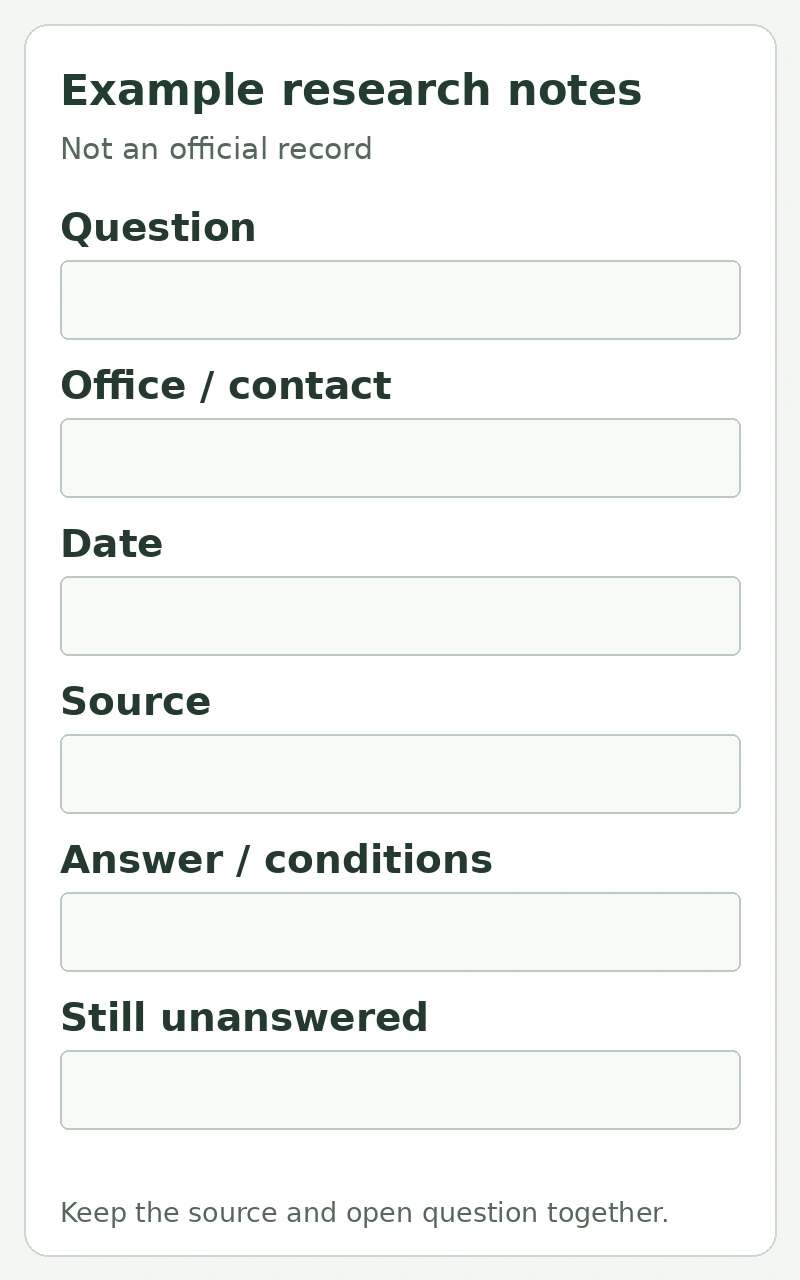
Record the parcel, question, staff member, office, date, source link, answer, conditions and unresolved items. After a call, email your summary and ask staff to correct misunderstandings. Silence is not confirmation.
Copy-and-paste email
Subject: Preliminary planning questions — parcel [________]
Hello [Planning Office],
I am considering buying parcel [________] in [jurisdiction: ________], near [location/map link: ________].
My intended use is [________].
Could you please confirm:
- Is your office the correct zoning authority?
- What zoning district, overlays and parcel-specific conditions apply?
- Is this use permitted, subject to additional approval, or prohibited?
- What should I verify about legal-lot status, setbacks, frontage and access?
- Where can I find the current code, application requirements and fees?
Optional — land split: I hope to create [___] lots. Which process and minimum requirements apply?
Optional — septic: Which office handles site evaluation and septic approval?
I understand this is a preliminary inquiry, not an approval request. Please identify any question requiring a formal determination or another office.
Thank you, [Name/contact]
Short phone-call checklist
- Confirm the office and parcel.
- Explain your specific use.
- Ask about zoning, lot status and major constraints.
- Request code links and the next application step.
- Note the staff member, date and unanswered questions.
- Send a written follow-up.
Continue your property investigation
Open LandGauge’s Research Hub, choose your state, then the relevant county or town. Follow its official planning resources to confirm the correct office. Use the locality page’s Property Review link to begin organizing your findings, then record answers, sources and open questions in your property review.
Then return to the due-diligence checklist to continue checking access, utilities, title and other risks. For the broader picture, see what to verify before calling vacant land buildable. LandGauge helps organize your investigation; you and the appropriate authorities complete the verification.
Sources & Official Resources
Primary sources that support the information in this guide. Requirements and record systems vary by jurisdiction — always confirm with the agency responsible where the property is located.
- Town of Simsbury, ConnecticutPlanning and Community Development Department
Example of municipal administration of local zoning and separate building-code responsibilities.
- Town of Simsbury, ConnecticutPlanning application forms
Examples of zoning, special-exception, wetlands, subdivision and pre-application routes; local requirements vary.
- Fairfax County, VirginiaZoning Requirements — What Can I Do With My Property?
Use tables, setbacks, development conditions and private restrictions.
- King County, WashingtonLegal Lot Status Information and Determination
June 2020 handout distinguishing tax parcels from legal lots. Legal-lot recognition does not guarantee buildability; obtain current parcel-specific requirements.
- King County, WashingtonPre-application Meeting Information and Checklist
January 2026 document. Page 2 explains that preliminary pre-application guidance does not assure approval.
- Connecticut Department of Public HealthSubsurface Sewage Disposal Systems
Local health permitting and additional state roles; includes standards effective September 2026.
Related guides
- GIS & Parcel ResearchHow to Find Your Property's Parcel Number, GIS Map, and Land RecordsFind your land's parcel number, county records, and GIS map, then explore zoning and property research with LandGauge's local research resources.
- ZoningHow to Research ZoningZoning determines what you can build. Reading code carefully is faster than learning by denial.
- ZoningDoes Residential Zoning Mean You Can Build a House?A residential zoning label is only one part of the answer. Separate allowed use, lot eligibility, and project approvals before relying on a vacant-land listing.
- ZoningHow to Verify Zoning on LandWhere to look up zoning, how to read the ordinance, and what questions to ask the planner.