Can You Split Land Without Utilities? What “Power Nearby” Really Means
A power line crossing or bordering a property does not necessarily mean the property can connect. Learn what to verify before relying on utility claims or estimating a land split.
Some jurisdictions may allow land to be divided before utility connections are installed. Approval to divide is different from approval to build on or serve each resulting lot, and a nearby utility line does not establish capacity, connection rights, an affordable connection, or permission to cross another property.
LandGauge Audio Guide
Listen to this guide
Leonard explains why nearby utility infrastructure is only a starting point, especially when evaluating a possible land split.
Listening time: 1 minute 20 seconds
Prefer reading? Continue with the full guide below.
A listing phrase such as “power nearby” can be a useful lead. It is not a complete answer about service. The same distinction matters for water and sewer—and becomes more important when one property may become several lots.
Requirements vary by property, provider, proposed use, and jurisdiction. Confirm current information directly with the responsible utility providers and government agencies, and obtain property-specific professional estimates where appropriate. Keep assumptions separate from verified facts.
Quick answer
Some jurisdictions may allow land to be legally divided before utility connections are installed. That does not mean every resulting lot is approved to build on, serviceable, or marketable. A utility line's physical presence does not establish available capacity, a legal right to connect, an affordable connection, or permission to cross another property.
The planning authority determines the land-division process. Each utility provider determines whether and how service may be supplied under its current rules. Both need to be asked about this parcel and the intended plan.
1. What common listing phrases actually tell you
Utility language is often brief because a listing cannot contain the provider's full engineering and approval process. A statement may be technically accurate while remaining incomplete for the buyer's intended use. Treat it as a question to investigate, not as proof or as a defect.
Listing phrase comparison
A phrase may be technically accurate and still leave important questions unanswered for the buyer’s intended use.
Power nearby
- What it may suggest
- Electrical infrastructure may be in the area.
- What remains unverified
- Serving utility, authorized connection point, capacity, route, easements, design, timing, and cost.
Utilities available
- What it may suggest
- One or more utility systems may be near or intended to serve the area.
- What remains unverified
- Which utilities, which provider, present availability, connection requirements, capacity, and total owner cost.
Utilities at the road
- What it may suggest
- Infrastructure may follow the road corridor.
- What remains unverified
- Whether this parcel can connect, where a crossing is allowed, and what extension, permits, easements, or upgrades are required.
Utilities at the property line
- What it may suggest
- Infrastructure may be close to a mapped parcel boundary.
- What remains unverified
- Exact location, ownership, capacity, connection rights, survey relationship, design, and cost.
Utility service area
- What it may suggest
- The parcel may fall within a provider's general territory.
- What remains unverified
- Whether service is currently offered to this parcel and proposed use, with capacity and an acceptable route.
Connected utilities
- What it may suggest
- A meter, lateral, service equipment, or prior account may exist.
- What remains unverified
- Whether service is active, adequate, transferable, compliant, and usable for the intended project or each proposed lot.
Capacity confirmed
- What it may suggest
- A provider may have reviewed a stated load or project at a particular time.
- What remains unverified
- Who confirmed it, in writing, for which use and lots, for how long, and subject to which design, fees, and approvals.
Keep five evidence levels distinct: a listing claim reports what was advertised; a preliminary assumption supports an early screen; a provider statement records what the responsible utility said; recorded evidence preserves documents such as an easement; and a verified conclusion combines the controlling evidence for the specific parcel and plan.
2. A visible power line does not answer the connection question
A pole, transformer, overhead line, underground marker, or neighboring meter establishes an observation. Ask the actual electric utility to confirm:
- Whether the parcel is within its service territory
- The closest authorized connection point
- Whether sufficient capacity currently exists
- Whether a transformer or system upgrade may be required
- Whether the line must be extended
- Whether trenching, poles, engineering, or road crossings may be required
- Whether an existing or additional easement is needed
- Preliminary connection, meter, deposit, or extension charges
- Whether every proposed lot can receive service
Do not apply a generic nationwide cost range. Providers use different designs, allowances, schedules, and construction responsibilities. The useful estimate is a current, property-specific response that states what the utility will do, what the owner must do, and how long the response remains valid. The power availability and connection-cost guide provides the deeper provider workflow.
3. A utility easement does not guarantee utility service
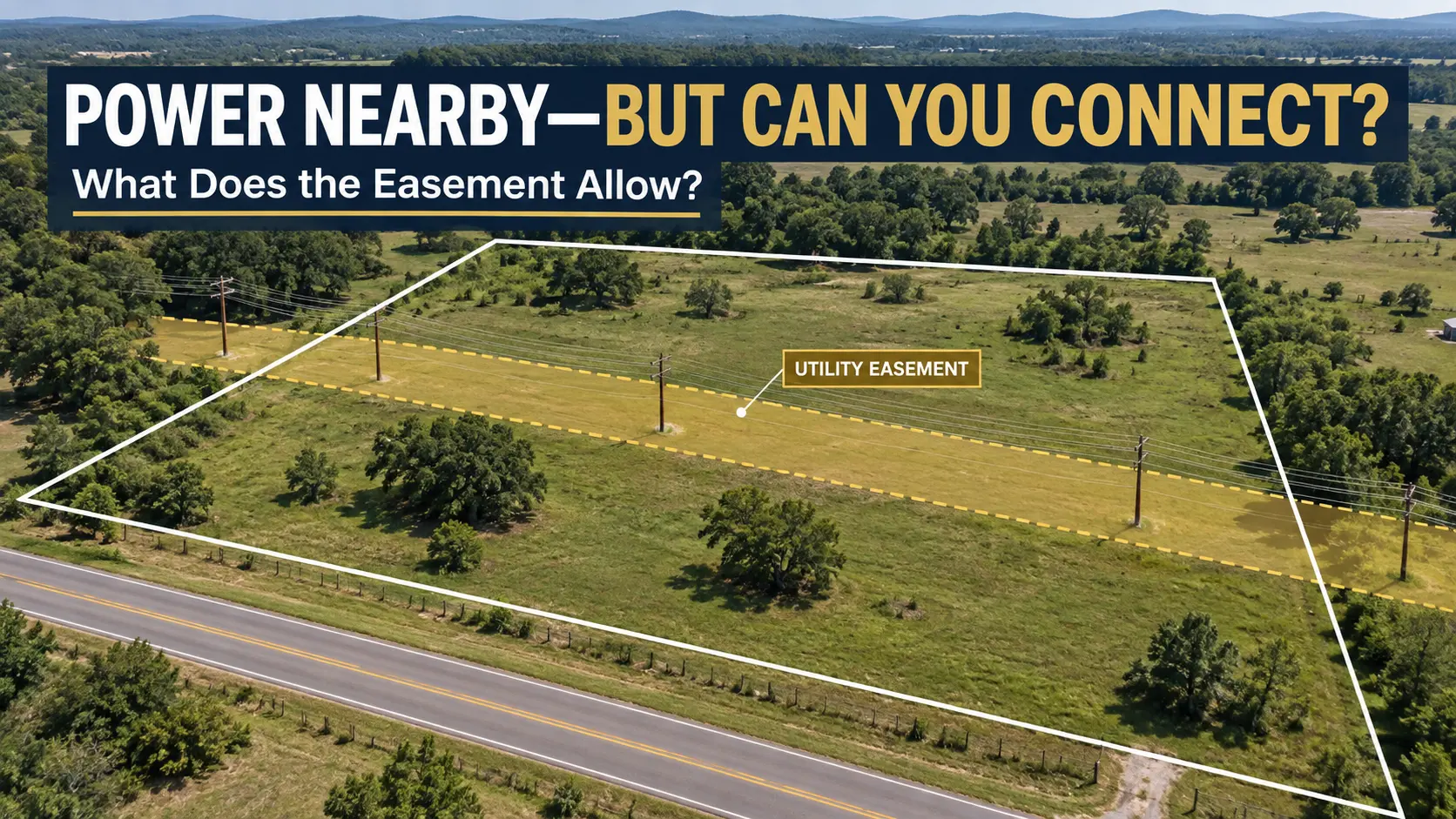
The featured image shows why the distinction matters: infrastructure and an easement corridor can be physically present on one parcel while the connection question remains unanswered.
A recorded utility easement may give a named utility or another easement holder the right to install, access, operate, or maintain infrastructure. The exact rights depend on the recorded document. An easement burdening the property does not automatically give the owner a right to connect to that infrastructure.
The easement's location and terms may affect buildings, grading, fencing, trees, driveways, or future lot layouts. Obtain the recorded instrument, identify its holder, review its legal description and exhibits, and confirm current requirements with the utility and jurisdiction. Use the guide to finding a deed, plat, or recorded easement to locate the source document. Do not draw a legal conclusion without the recorded instrument and qualified review where needed.
4. Water and sewer “nearby” require separate verification
Water and sewer are separate systems, often managed by different providers or districts. For each one, confirm:
- The responsible provider or district
- Main-line location and the authorized connection point
- Available system capacity for the intended use
- Whether service must cross a road or another property
- Extension, design, and construction requirements
- Tap, meter, connection, impact, or capacity-related charges
- Whether service is currently available to each proposed lot
- Any moratorium, service boundary, planned improvement, or timing condition
A mapped main or nearby hydrant does not answer these questions. Current answers should come from the responsible provider and jurisdiction, preferably in writing and tied to the parcel and proposed use. The broader vacant-land utilities guide helps organize power, water, sewer, communications, and extension questions together.
5. When public utilities are unavailable
Public utility service is not the only possible path in every jurisdiction. Preliminary investigation may include private wells, applicable water rights or drilling rules, septic and soil suitability, required setbacks and reserve areas, space for individual systems, shared-system restrictions, and health-district or environmental requirements.
Acreage alone does not prove that a well can supply water or that each proposed lot can support wastewater treatment. Review perc tests and septic feasibility, then place those answers within the complete buildability framework. Confirm the required testing and approval path with the responsible agencies and qualified professionals.
6. Why utility assumptions matter more when splitting land
A single existing connection may not be allowed or sized to serve multiple resulting lots. Each proposed lot may need an independent, legally acceptable service plan. Utility corridors and easements may change the feasible layout, and road frontage or legal access does not automatically create utility access.
Connection, extension, easement, wastewater, and owner-side construction costs can materially change a preliminary split. A property may be legally divisible while one or more resulting lots remain difficult or expensive to serve. Approval to divide does not guarantee buildability, utility service, value, or profit.
Start with Can You Split Land Into Two Lots?, then investigate the full budget with How Much Does It Cost to Split Land? and the Land Split Calculator.
7. The resale problem created by an unverified assumption
An unanswered utility question does not disappear after closing. It becomes part of the next decision about the property.
A buyer who relies on an incomplete utility statement may later need to resolve or accurately describe that same uncertainty when selling the property or resulting lots. The answer may turn out to be favorable, manageable, expensive, delayed, or unavailable. Until the responsible sources confirm it, keep the status unresolved rather than assigning a speculative effect on price.
8. How to verify utility claims before relying on them
- Save the exact listing statement or seller representation.
- Identify the correct utility provider or service district.
- Confirm the parcel using its address, APN, legal description, or mapped location.
- Ask for the nearest authorized connection point and current capacity.
- Ask what extensions, transformers, meters, taps, crossings, or upgrades may be required.
- Identify existing or required easements.
- Obtain and review relevant recorded documents.
- Confirm split, plat, utility-plan, and building requirements with the planning department.
- Obtain property-specific professional estimates where appropriate.
- Record the source, agency, contact, date, scope, and remaining questions.
- Update the preliminary split analysis with better information.
LandGauge supports this organized investigation. It helps preserve the listing claim, provider statements, recorded evidence, preliminary assumptions, and unresolved questions in one property review; it is not the authority that grants utility service or subdivision approval. Continue through the land due-diligence checklist so utility findings remain connected to access, zoning, title, wastewater, and site conditions.
9. Questions to ask the utility provider
- Is this parcel in your service territory?
- What is the closest authorized connection point?
- Is sufficient capacity currently available?
- Is service located on this parcel, across the road, or on another property?
- Is a new easement required?
- Are line extensions, transformers, or system upgrades required?
- Can each proposed lot receive separate service?
- What application, engineering, and design process is required?
- What preliminary fees or deposits should be investigated?
- Who else must approve the work?
- Can the response be obtained in writing, and how long is it valid?
10. Questions to ask the planning department
- Can the land be divided before utilities are installed?
- Must each proposed lot demonstrate a utility plan?
- Are public connections required when service is available?
- Are wells or septic systems permitted?
- What utility, access, and easement information must appear on the plat?
- Are improvement agreements, bonds, or guarantees required?
- Could the easement affect setbacks, access, or lot layout?
- Which agencies must review the proposed split?
Final takeaway
Separate location from availability, and separate a legal division from a usable lot. Confirm utility service with the responsible providers, confirm division and development requirements with the responsible jurisdiction, review recorded easements on their actual terms, and obtain property-specific professional estimates.
Do not present assumptions as verified facts. No guide or calculator can guarantee access, capacity, buildability, approval, value, or profit. Verify before you rely.
Frequently asked questions
Related guides
- UtilitiesHow to Verify Power Availability and Connection Costs Before Buying LandVerify the serving utility, connection point, capacity, route, easements, and cost drivers before treating power as available on vacant land.
- Lot SplitsHow Much Does It Cost to Split Land?The survey and filing fees may be only the beginning. Learn which costs to investigate before deciding whether a 2–4 lot split makes financial sense.
- Due DiligenceHow to Tell if Land is Buildable: A Step-by-Step Due Diligence GuideA practical, twelve-point framework for evaluating whether a vacant parcel can realistically support a home or small development — before you make an offer.
- UtilitiesUtilities Nearby? Verify Connection Requirements and Costs Before Buying LandNearby homes and utility lines are useful clues—not a connection commitment. Learn who to ask, what costs to investigate, and how to save unresolved questions in LandGauge.