How Much Does It Cost to Split Land?
The survey and filing fees may be only the beginning. Learn which costs to investigate before deciding whether a 2–4 lot split makes financial sense.
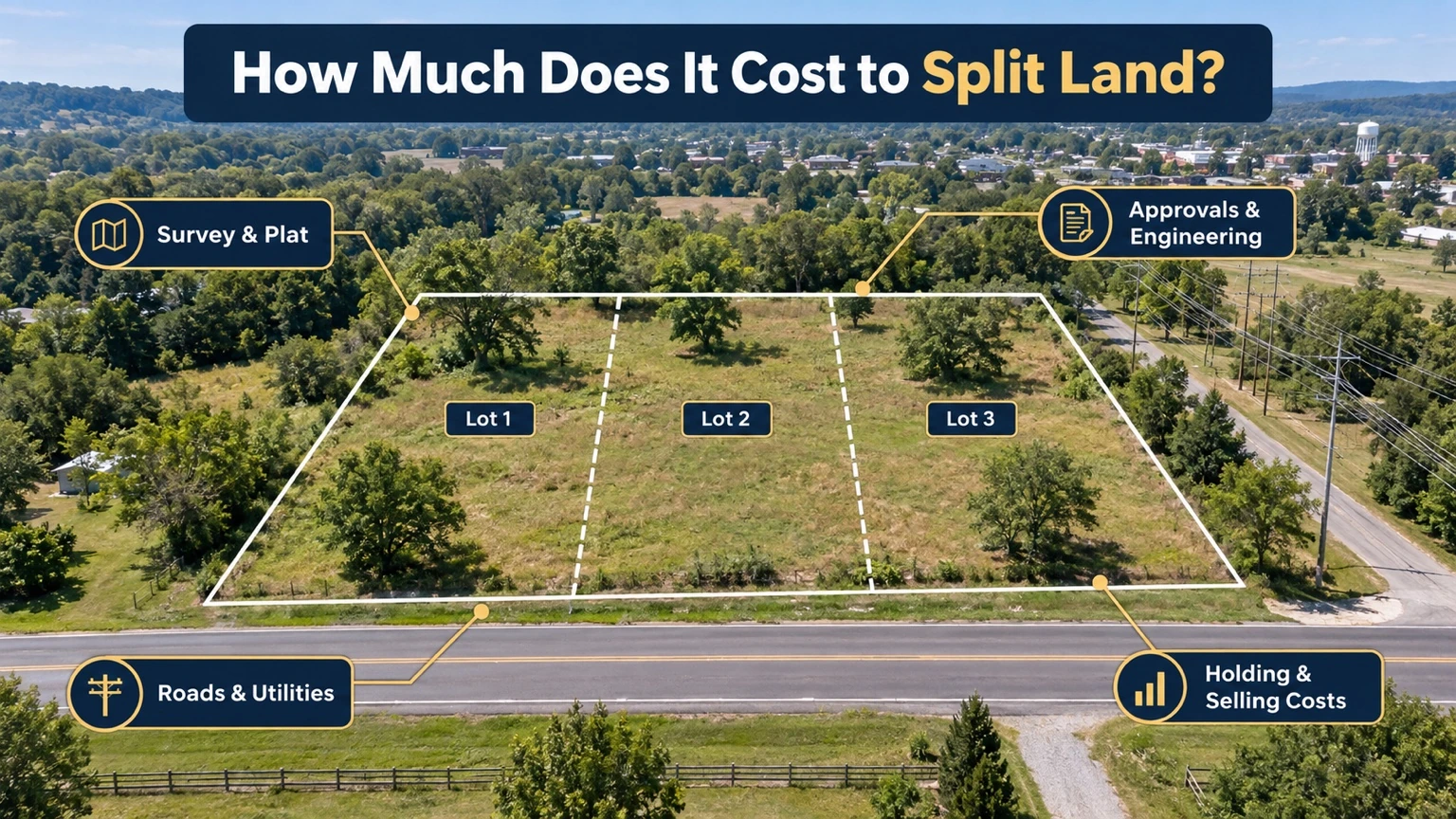
There is no universal cost to split land. The total depends on the parcel, the reviewing jurisdiction, the number and design of the proposed lots, required professional work, access, utilities, site conditions, approval time, and selling plan.
LandGauge Audio Guide
Listen to this guide
Leonard explains why survey and filing fees are only part of a preliminary 1–4 lot split budget.
Listening time: 1 minute 21 seconds
Prefer reading? Continue with the full guide below.
A legal division creates separate parcels in the public record. It does not automatically make those parcels accessible, serviceable, buildable, or marketable. Those outcomes may require different approvals, designs, construction work, easements, utility commitments, and professional conclusions.
Use this guide to identify costs worth investigating before you buy or commit to a two-, three-, or four-lot plan. Requirements vary by property and jurisdiction, so verify the current process with the responsible agencies and use qualified professionals for property-specific advice and estimates.
Quick answer
Start with the full path from one existing parcel to legal, usable lots—not just the survey fee. A preliminary budget may need to include the purchase and closing, survey and plat, applications and recording, engineering and studies, access and roads, drainage, utilities and wastewater, site work, professional review, financing, holding time, selling expenses, and contingency.
The Land Split Calculator can organize those assumptions for two, three, or four potential lots. It is a preliminary screening tool, not proof of approval, buildability, value, or profit.
1. Survey and plat costs
A licensed surveyor may need to research records, locate or set corners, prepare a boundary or topographic survey, design proposed lines, prepare a preliminary or final plat, respond to review comments, and create recordable documents.
Ask whether the quote includes field work, monuments, legal descriptions, revisions, agency coordination, recording copies, and work needed after approval. Difficult terrain, uncertain boundaries, missing monuments, encroachments, or a complicated parcel history may increase the work.
The deed, plat, and recorded easement guide explains which records can help you begin, but public maps are not substitutes for a boundary survey.
2. Planning, application, and recording fees
Ask the city, county, or other reviewing authority which division process applies. Possible costs include a pre-application meeting, subdivision or partition application, completeness review, notices, hearings, plan review, inspections, impact fees, addressing, tax-map updates, and recording.
Do not assume the fee schedule tells the entire story. Ask whether another agency reviews roads, fire access, wastewater, water, drainage, environmental conditions, or utilities—and whether those reviews have separate charges.
3. Engineering and required studies
The reviewing authority may require civil drawings, grading and drainage plans, stormwater calculations, road design, utility plans, erosion control, traffic or sight-distance work, geotechnical review, environmental studies, or other technical documents.
The scope should come from the parcel and the current review path. Obtain written proposals that state assumptions, exclusions, revision limits, agency coordination, and whether construction administration or as-built work is included.
4. Access, roads, and drainage
Legal frontage does not prove that each new lot can receive an acceptable driveway or road. Investigate access rights, driveway permits, sight distance, culverts, grades, turnarounds, emergency access, private-road standards, dedications, maintenance agreements, and drainage improvements.
Separate the cost to obtain approval from the cost to build the improvement. Include design, permits, materials, mobilization, inspection, testing, easements, ongoing maintenance, and any off-site work assigned to the project.
5. Water, sewer, septic, power, and other utilities
For every proposed lot, identify the provider or authority and ask about availability, capacity, connection rules, meters, tap or impact charges, extension distance, easements, trenching, restoration, and owner-side work.
Where sewer is unavailable, investigate site evaluation, soil or perc work, system design, permits, installation, and required replacement area. Where public water is unavailable, investigate well feasibility, drilling, testing, storage, treatment, and power. “At the road” and “nearby” are not service commitments or cost estimates.
6. Site conditions and physical constraints
Slope, rock, unsuitable soil, flood or drainage conditions, wetlands, vegetation, demolition, existing structures, contamination concerns, easements, rights-of-way, and irregular boundaries can change the design or cost.
Review each proposed lot separately. A constraint may fall mostly inside one lot, reduce its building envelope, lengthen its driveway, or force a utility crossing. Use agency records for screening and qualified professionals where field or technical conclusions are needed.
7. Holding, financing, and selling costs
Approval and construction take time. A preliminary budget may need interest, lender charges, taxes, insurance, security, mowing or maintenance, professional renewals, permit extensions, and the cost of capital while the property is held.
Selling costs may include brokerage, advertising, photography, signs, title and escrow charges, buyer concessions, transfer charges, closing costs, and continued holding time between lot sales. Ask a tax professional about tax consequences for your circumstances.
When estimating finished-lot proceeds, use supported comparable sales and the process in How to Calculate Land Value. Do not rely on asking prices or assume every proposed lot will have the same value.
8. Contingency and unresolved costs
Contingency is not a replacement for research. It is an allowance for uncertainty that remains after reasonable investigation. A parcel with confirmed requirements and current quotes may justify a different allowance than one with unresolved access, utility, drainage, boundary, or approval questions.
Keep unknowns visible. Record a range, source, date, assumptions, exclusions, and next action for every important line. Update the budget when the agency, provider, surveyor, engineer, contractor, title professional, or other qualified source supplies better evidence.
9. Mobile worksheet: costs to investigate
Preliminary 1–4 lot split cost worksheet
Record the source and date beside every estimate. Leave an item unresolved rather than entering a number you cannot support.
Swipe sideways to see all worksheet columns.
| Cost category | Estimate | Source / status |
|---|---|---|
| Property purchase and closing | $________ | ________ |
| Survey and plat preparation | $________ | ________ |
| Planning, application, and recording fees | $________ | ________ |
| Engineering and required studies | $________ | ________ |
| Access, driveway, road, and drainage work | $________ | ________ |
| Water, sewer, septic, and power | $________ | ________ |
| Site preparation and other property conditions | $________ | ________ |
| Legal, title, and professional review | $________ | ________ |
| Financing and holding costs | $________ | ________ |
| Marketing, commissions, and selling costs | $________ | ________ |
| Contingency | $________ | ________ |
Preliminary gross spread
Assumed gross finished-lot value minus the property basis and project costs included so far. It is a screening number, not completed profit.
The preliminary gross spread is useful only if the budget contains the material costs. For a fuller distinction between spread and profit, read How Much Profit Can You Make Splitting Land?.
10. Questions to ask before buying
- Which government authority controls this parcel and division?
- Which process applies to a two-, three-, or four-lot proposal?
- What minimum area, width, frontage, access, and dimensional standards apply?
- Does the parcel have prior divisions, easements, covenants, overlays, or other restrictions?
- Which surveys, plans, reports, studies, hearings, dedications, and improvements may be required?
- Can each lot obtain legal and physical access, water, wastewater, power, and other needed service?
- What agency, provider, professional, financing, holding, and selling costs remain unpriced?
- How long might review and construction take, and which costs continue during that time?
- What evidence supports the proposed finished-lot values?
- Which assumptions could eliminate a lot or materially change the plan?
If your first concept is two lots, use Can You Split Land Into Two Lots? to review the parcel-specific legal, access, utility, and physical questions before relying on the layout.
If you are deciding whether you or the other party should pay for survey work, read Who Pays for a Property Survey—Buyer or Seller?
Final takeaway
The cost to split land is the cost of the whole path—not merely drawing and recording new lines. Build the preliminary budget around what must happen to create legal, accessible, serviceable, usable, and marketable lots. Then verify each major assumption with the responsible agency, provider, or qualified professional.
No calculator or guide can promise approval, buildability, value, or profit. The goal is to expose the unknowns early enough to make a better-informed decision.
Frequently asked questions
Related guides
- Land Value & CompsHow to Estimate Profit From a 1–4 Lot Land SplitLearn how to estimate potential profit from splitting land into two, three, or four lots—and why a preliminary value spread is not the same as completed profit.
- Lot SplitsFour Proposed Lots Do Not Mean Four Buildable LotsA four-lot sketch is only a starting point. Learn how to verify legal division, buildable envelopes, access, utilities, wastewater, and evidence for every proposed lot.
- Lot SplitsCan You Split Your Land? Test the Numbers and Research the ParcelFour proposed lots might look promising. Compare three and two, identify the right parcel even without its number, and investigate what the land actually allows.
- Lot SplitsFound Land on Zillow? Verify the Split Before You BuyZillow, Redfin, and Realtor.com can help you find a possible land-split opportunity. Learn what listing sites can show, what they cannot verify, and how to underwrite two-, three-, and four-lot scenarios before you buy.